Your toddler has been eyeing the loo for weeks. They’ve started tugging at their nappy after a wee. The weather forecast is finally looking warm, and a quiet voice in your head whispers: maybe it’s time. So, if you’ve been waiting for the right moment to ditch the nappies, you’re almost certainly looking at the right season. Potty training in summer is, by a wide margin, the easiest time of year to make the leap. This guide will walk you through it step by step, with practical advice grounded in our Hounslow toddler-room experience.
We’ll cover when your child is genuinely ready, why summer makes everything easier, how to plan a calm 7-day approach, and how to handle the inevitable wobble without panicking. There’s a printable-style readiness checklist, a kit list, and a comparison of common setbacks with what to do about each.
When Is the Best Time to Start Potty Training? (Quick Answer)
Summer is the best time to start potty training in the UK: lighter clothing, garden access, and faster laundry make accidents easier to manage. Most children show signs of readiness between 18 months and 3 years. With a calm, consistent approach over 3 to 7 days, many toddlers will be using the potty reliably during the day, though night dryness usually comes months or even years later.
Key Takeaways
- Readiness matters more than age. Some children are ready at 18 months; others not until well past 3. Look for signs, not birthdays.
- Summer is the practical winner — bare legs, garden floor, faster drying, and longer days for outside play.
- Most daytime training takes 3 to 7 days for a child who is genuinely ready. Night dryness takes much longer.
- Setbacks are part of the process. A few accidents are not a failure; they’re feedback.
- Your nursery is your partner in this. A consistent approach between home and nursery dramatically speeds up the process.
💜 Choosing a nursery in Hounslow that will partner with you on potty training?
You’re warmly invited to book a free showaround at Purple Bees — we’ll show you exactly how our toddler-room team supports families through this milestone.
Why Potty Training in Summer Works So Well
There’s a reason every UK parent gets the same advice from grandparents, health visitors, and their NCT WhatsApp group: do it in summer if you can. The reasons are surprisingly practical.
- Lighter clothing. Stretchy shorts and dresses come down in two seconds. Compare that to dungarees and tights in February.
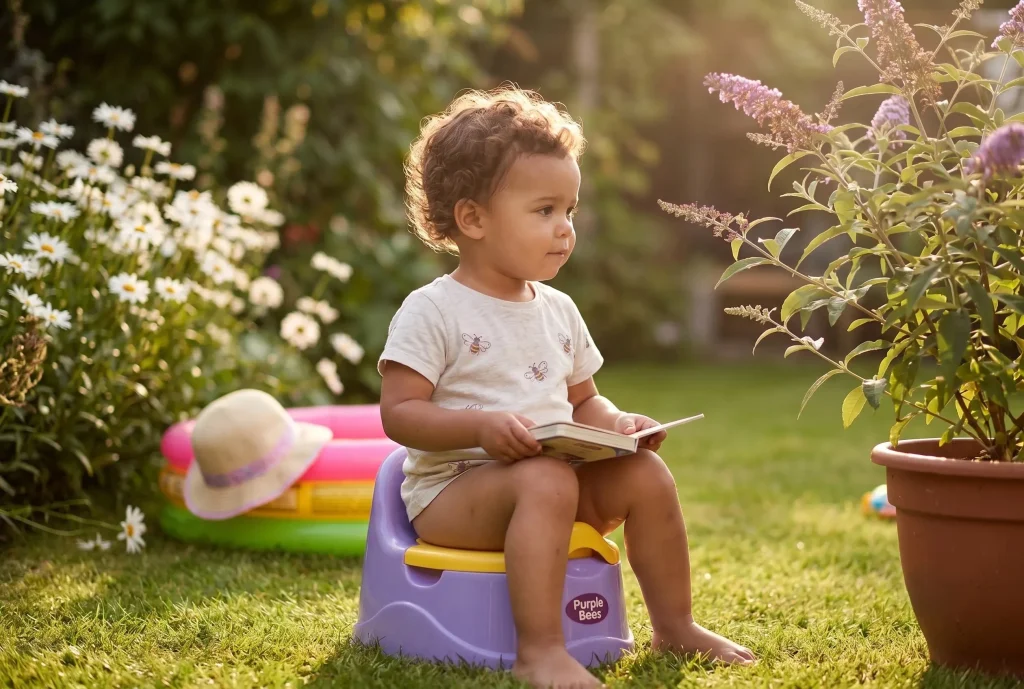
- Garden access. Many toddlers in the early stages benefit from “nappy-off time” outdoors, where small accidents matter less and your hallway carpet stays safe.
- Faster laundry. Wet pants on the line by 10am can be dry and back in the drawer by lunch. Winter washing schedules are far less forgiving.
- Longer, calmer days. You have more daylight hours to spot the wiggle, react to the call, and reach the potty in time.
- Holiday pause. If you’re taking annual leave, you have the rare gift of a few unbroken days at home to focus.
That said, summer isn’t magic. Readiness still matters more than the season — and we’ll come to that next.
How Do You Know Your Toddler Is Ready? (Readiness Checklist)
The NHS is clear: there’s no “right” age. Most children show signs of readiness somewhere between 18 months and 3 years, though some take a little longer. So, look for several of these signs appearing together, rather than one in isolation:
🧠 Awareness signs
☐ Tells you (or shows you with a face, a wiggle, a hiding place) when they’re having a wee or a poo
☐ Knows the words for wee, poo, and potty
☐ Shows curiosity about the toilet, the potty, or other people using one
☐ Pulls at a wet or dirty nappy, or asks to be changed
💪 Physical signs
☐ Can sit comfortably for several minutes
☐ Able to walk to a potty by themselves
☐ Pulls trousers and pants up and down (with a bit of help)
☐ Stays dry for at least 1 to 2 hours during the day
☐ Does a “wee face” or pause that signals it’s happening
🗣 Communication signs
☐ Follows simple two-step instructions (“come and sit on the potty”)
☐ Can say or sign that they need the toilet — even if the words are unclear
If you’re unsure whether their communication is on track for their age, our guide on toddler speech development milestones lays out what’s typical and when to ask for support.
How Long Does Potty Training Take?
The honest answer is: less than you fear, and longer than the internet promises.
- Day 1–3: Most accidents, lots of running, plenty of laundry.
- Day 4–7: Children with strong readiness signs often have a few accident-free days by this point.
- Weeks 2–4: Most children become reliably dry during the day. Although new situations (car journeys, soft play, the supermarket) still cause occasional accidents.
- 3–6 months on: Confidence with toileting in unfamiliar places.
- Night dryness: Usually 6 months to several years after daytime training. The NHS notes that night dryness happens when the body is biologically ready — not when parents want it to. Many children are still in pull-ups at night well into Reception class.
If you’ve seen a “potty train in 3 days” book or video and it didn’t work out that way for you — you’re not failing. You’re parenting a real child, not a marketing case study.
How to Potty Train in Summer: A 7-Day Plan
This is a calm, gentle plan that prioritizes connection over pressure. If your child seems distressed at any point, pause. Potty training is not a deadline.
Day 1 — The big switch
- Take the nappy off after breakfast.
- Stay close to home or the garden.
- Offer the potty every 30–45 minutes. Keep it casual, not anxious.
- Celebrate any wee or poo in the potty — but lightly. No party.
- Expect accidents. Stay neutral: “Whoops! That’s okay. Next one in the potty.”
Day 2 — Settle into the rhythm
- Continue at-home or garden focus.
- Spread the potty around the house if you have multiple floors.
- Read potty-themed books together.
- Offer plenty of fluids — counter-intuitive, but you want practice opportunities.
Day 3 — Short outings begin
- Try a brief walk to the local park or a short errand.
- Take a spare potty in the boot of the car if traveling.
- Offer the potty just before leaving and immediately on returning.
Day 4–5 — Building confidence
- Introduce “big kid pants” if you haven’t already. Let your child pick them.
- Continue regular prompts but begin spacing them out.
- Praise effort, not just success. “You told me! Brilliant.”
Day 6–7 — A normal-ish life returns
- Resume slightly longer outings.
- Expect setbacks when tired, excited, or unwell.
- If your child is in nursery, share your potty-training approach with their key person so you can stay consistent.
After this week, you’ll know whether your child was genuinely ready. If accidents are still constant and stress is rising, it’s perfectly okay to pause and try again in a month or two. There’s no medal for early.
Imagining a Toddler Training Scenario
Let’s picture a typical family example on a Saturday morning in July:
A two-and-a-half-year-old has been showing readiness signs for weeks — she pulls at her nappy, tells her dad when she’s done a wee, and wants to sit on the toilet “like Daddy.” They’ve cleared the weekend, set up the potty next to the back door, and put away the nappies for daytime.
By Sunday afternoon, there have been five wees in the potty and three on the kitchen floor. Mum is exhausted. By Wednesday — back at Purple Bees, her key worker following the exact same routine — she’s had two accident-free days. By the following Monday, she’s wearing pants confidently, with the occasional reminder.
This is a fair pattern — slower than the books promise, faster than parents fear. And almost always smoother when nursery and home are following the same plan.

What Equipment Do You Actually Need?
Most potty-training kits sold online are overkill. Here’s what genuinely helps:
🛒 Your Potty Training Kit List
Everything you actually need, nothing you don’t
One basic potty
(plus a second if you have multiple floors)
Easier than a toilet seat for early days.
6–8 pairs of pants
Enough for accidents and a wash cycle.
2–3 pairs of stretchy trousers
Quick on and off — no buttons, no zips.
Waterproof car seat / pushchair cover
Saves you from one bad afternoon ruining your car seat.
A small towel and antibacterial spray
Realistic, not optimistic.
A reusable wet bag
For accidents while you’re out.
A children’s book about potties
Reduces the mystery, normalises the act.
You don’t need: novelty potty chairs that sing, reward sticker apps, or pull-ups during the day (most experts agree these confuse the signal between “wet” and “dry”). Keep it simple.
How to Handle Common Setbacks (Without Losing Your Mind)
Almost every parent hits at least one of these. Here’s what they usually mean, and what to do.
When Should You Seek Extra Support?
Most potty-training journeys are bumpy but ordinary. However, there are a few patterns that warrant a chat with a health professional rather than another week of waiting:
- Your child holds poo for several days at a time, despite gentle encouragement
- Stools are unusually hard, painful, or distressing (a possible sign of constipation, which the NHS notes is very common during potty training)
- Daytime accidents are still constant after several genuine attempts spaced months apart
- Your child is dry, then suddenly soaking and unhappy about it — particularly if they’re showing pain when weeing
- You feel the process is causing real distress to your child or to you
In Hounslow, your local NHS Health Visiting Service is the first port of call. The Hounslow Health Visiting advice line is 0208 973 3490 (Monday to Friday, 9am to 5pm) — free, friendly, and explicitly used to support families through toilet training, sleep, and behavior. Hounslow’s three Family Hubs — in Brentford, Lampton, and Feltham — also host regular health visitor clinics, though most are by appointment via the advice line. As a backup, your GP can also refer your child for further support if needed.
How Purple Bees Supports Potty Training at Our Hounslow Nursery

At Purple Bees Day Nursery on Inwood Road in Hounslow (TW3), potty training is treated as a shared milestone, not a private home project. Our toddler-room team supports dozens of families through it every year,. We know how much smoother it goes when nursery and home are following the same plan.
In practice, that means:
- A welcome chat with your child’s key person before you start, so we know exactly how you’re approaching it at home.
- Consistent language — we use whatever words and phrases your family uses for the potty, the toilet, and bodily functions.
- Regular gentle prompts woven into the nursery day — before snack, before nap, before outside play.
- No shame, no fuss for accidents. Just a calm change, a wash, and back to play.
You can read more about our approach to early childhood independence on our curriculum page, or take a look at our guide on how to prepare your child for nursery — many of the same principles apply.
Purple Bees Day Nursery – Hounslow TW3
💜 Wondering how potty training would work in your child’s nursery routine?
Come and see for yourself. We’d love to welcome you for a quiet, no-pressure visit — you can book your free showaround at our Hounslow nursery here.
Book a Free Showaround93A Inwood Rd, Hounslow TW3 1XH · 020 8572 1919
Frequently Asked Questions About Potty Training in Summer
A gentle reminder
This article is for general parenting information only and is not a substitute for medical advice. If you have ongoing concerns about your child’s toileting, constipation, or development, please speak to your GP or health visitor.