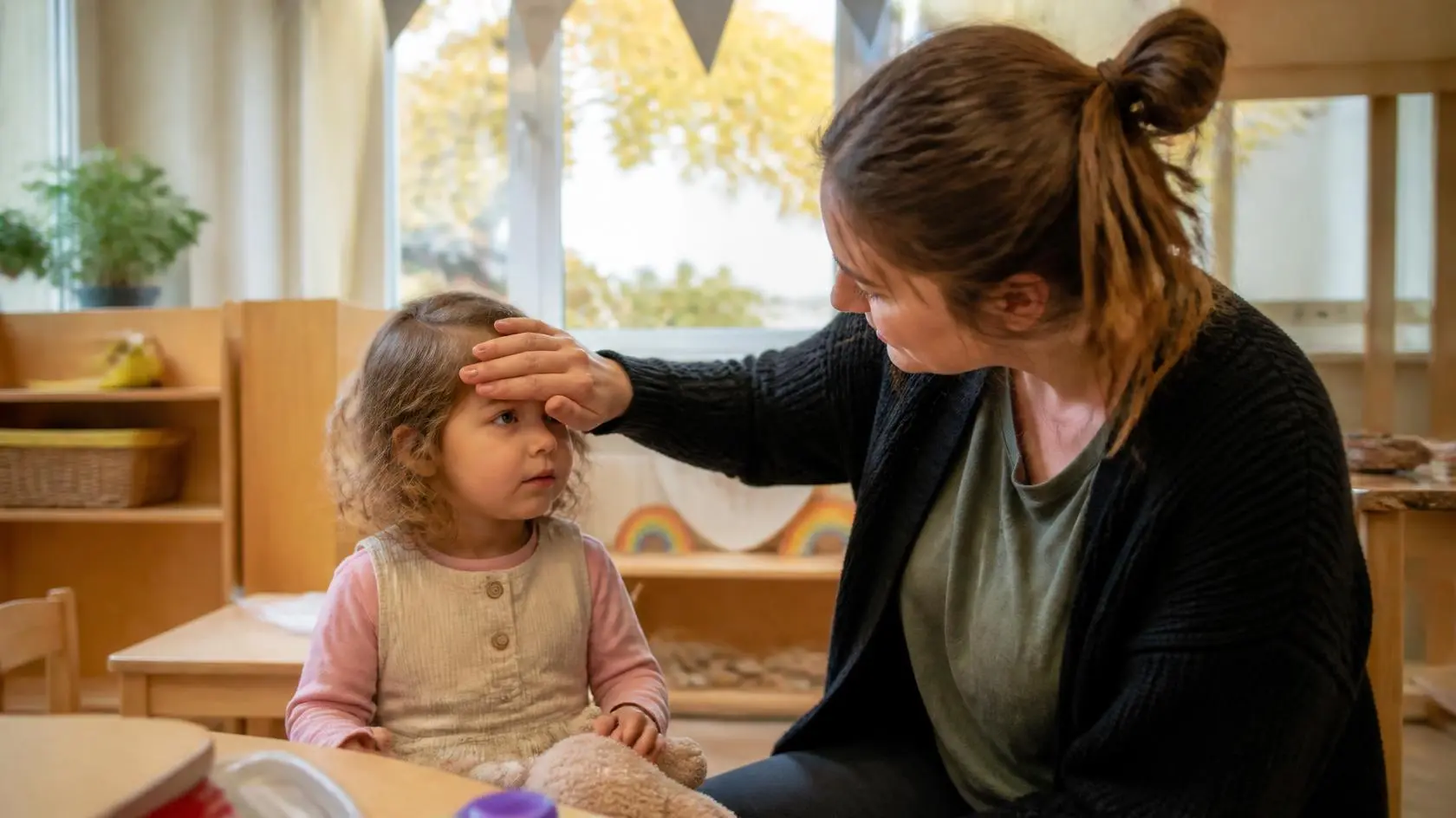
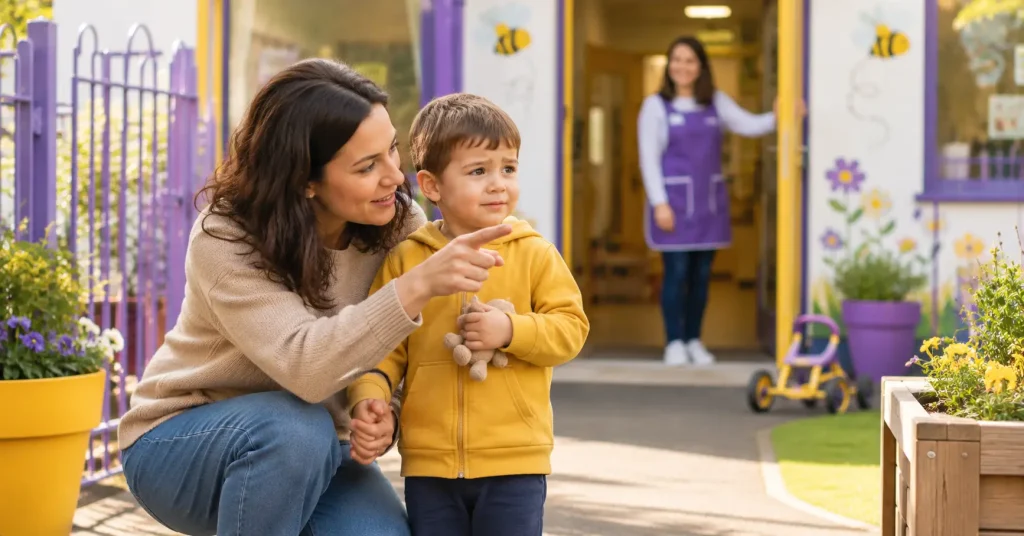

It’s 8:15am. You’re three minutes from being late, your toddler has gone limp at the nursery door, and somewhere between the car park and the cloakroom your morning has unraveled. If you’ve stood there clutching a snot-soaked cardigan wondering whether you’re getting this all wrong — you’re not. You’re parenting a small person whose brain hasn’t yet learned how to handle big feelings. Fortunately, that’s exactly where the 3-3-3 rule for kids quietly works wonders.
This guide explains what the 3-3-3 rule is, why it works, when to use it, and how the team at our Hounslow nursery weave it into our daily practice — including at the trickiest moment of all: drop-off.
What Is the 3-3-3 Rule? (Quick Answer)
The 3-3-3 rule is a grounding technique that calms an anxious child in under a minute. Ask your child to name 3 things they can see, 3 sounds they can hear, and 3 parts of their body to move. The exercise interrupts panic by reconnecting the brain to the present moment.
Key Takeaways
- The 3-3-3 rule = 3 see, 3 hear, 3 move. No equipment, no training, no quiet room needed.
- It works by gently shifting a child’s focus away from anxiety and back into the here-and-now.
- Best suited for ages 3+, with a simplified version that works beautifully for younger toddlers.
- Useful before nursery drop-off, after a meltdown, at bedtime, or during big transitions like a new sibling or starting school.
- It’s a calming tool, not therapy. Persistent or escalating anxiety should always be discussed with your GP or health visitor.
💜 Choosing a nursery in Hounslow right now?
You’re warmly invited to book a free show around at Purple Bees — there’s no pressure to enroll, and you’ll see techniques like this used in practice.
You can also check whether you qualify for free childcare hours for 2-year-olds in Hounslow.
Why Do Toddlers and Young Children Get So Anxious? Understanding Separation Anxiety
Anxiety in children rarely looks like the “anxious adult” we picture. In a small child, it can show up as:
- Clinging or “going floppy” at the nursery door
- Sudden tummy aches before nursery
- Repetitive questions (“Are you coming back? Are you coming back?”)
- Tears that seem to come out of nowhere
- Acting out — hitting, kicking, shouting
These are rarely signs of a “bad day” or a child being “difficult”. In fact, they’re almost always a young nervous system trying to process something that feels too big — a new room, a new face, a separation, an unexpected change in routine. Grounding techniques like the 3-3-3 rule are designed to give that nervous system a soft place to land.
How to Do the 3-3-3 Rule, Step by Step

You can use this on the school run, in the queue at Tesco, at the nursery gate, or in the back seat of the car. Here’s the full sequence — it takes 30 to 60 seconds.
Step 1: See — Name 3 things you can see
Get down to your child’s eye level. In a soft voice, ask:
- “Can you spot three blue things?”
- “What three things can you see right now?”
The point is to engage their visual system, because the brain regions that process sight sit physically further from the panic centers, so this lights up a calmer area of the brain.
Step 2: Hear — Name 3 sounds you can hear
“Now let’s listen. Can you hear three different sounds? Maybe a bird, a car, my voice…”
Whisper this step. Whispering naturally slows the breath, which is itself calming for both of you.
Step 3: Move — Wiggle 3 parts of your body
“Let’s wiggle three things. Wiggle your toes. Now your fingers. Now your nose.”
Movement releases the physical tension that often gets locked into a child’s body during anxiety — clenched jaws, hunched shoulders, tight little fists.
That’s it. Three senses, three counts, under a minute, anywhere.
Why Does the 3-3-3 Rule Actually Work?
When children become overwhelmed, their brain enters fight-or-flight mode. This response is run by the amygdala — a tiny, ancient region of the brain whose only job is to keep us safe. Unfortunately, the amygdala doesn’t distinguish between “a tiger is chasing me” and “Mummy is leaving me at nursery.” To this part of the brain, both feel equally urgent.
Grounding exercises like the 3-3-3 rule gently reroute attention through the senses. As a result, by engaging sight, hearing, and movement deliberately, you give the prefrontal cortex — the thinking, calming part of the brain — a chance to come back online.
In practice, you can actually see this happen: shoulders drop, breath slows, eye contact returns. It’s the same principle behind the better-known 5-4-3-2-1 grounding technique used by YoungMinds and other UK mental health charities — just simplified for smaller minds.
When You Should Use the 3-3-3 Rule? (5 Common Moments)
| Situation | Example phrasing |
|---|---|
| Nursery drop-off | “Before I go, can you find three yellow things in the classroom?” — Replaces panic with curiosity |
| Bedtime worries | “Three sounds you can hear in your bedroom?” — Calms a busy brain before sleep |
| After a meltdown | “Let’s wiggle three things together — toes first.” — Helps a child come back into their body |
| Big transitions (new sibling, moving house, starting school) | “Three things you love about today?” — Anchors them in the present |
| Public meltdowns (supermarket, soft play) | “Quick game — three sounds, go.” — Quick, no equipment, works anywhere |
What If You’re the Anxious One at Drop-Off? (A Note for Parents)
Parents often forget that nursery drop-off triggers their own nervous system, too. The lump in your throat as you walk back to the car is real — and the 3-3-3 rule works just as well on you as it does on your child. Try it in the car park on the way back: three things you can see (the brick wall, your steering wheel, a tree); three sounds you can hear (traffic, a bird, your own breathing); three parts of your body to move (shoulders, jaw, hands). Ultimately, a calmer parent makes a calmer child — and the school run gets gentler for both of you.
How Do You Choose the Right Calming Technique for Your Child?
Not every technique works for every child. Use this quick checklist to pick what to try first:
✅ Is your child verbal? → 3-3-3 rule, 5-4-3-2-1, breath counting
✅ Pre-verbal or very young? → Sensory grounding (cold cloth, weighted blanket, hugging tight), point-and-name
✅ Highly visual? → Start with the “see” step, or use “I Spy” games
✅ Movement-driven? → Start with the “move” step, or try jumping/stomping
✅ Sound-sensitive? → Whispered version of 3-3-3, or “find one quiet sound”
✅ Anxious specifically in transitions? → Pair 3-3-3 with a consistent goodbye ritual; our guide on how to settle a child into nursery walks through this in detail.
The 3-3-3 Rule vs Other Calming Techniques
| Technique | Best for |
|---|---|
| 3-3-3 rule (30–60 secs) | Mid-level anxiety, transitions, ages 3+ |
| 5-4-3-2-1 grounding (1–2 mins) | Older children & adults, deeper anxiety |
| Belly breathing (2–5 mins) | Bedtime, sustained calm |
| Sensory hug / weighted blanket (instant) | Pre-verbal toddlers, sensory overload |
| Counting backwards (30 secs) | Older children, mild overwhelm |
When Should You Seek Extra Support?
The 3-3-3 rule is a wonderful everyday tool. However, it isn’t therapy. Speak to your GP, health visitor, or your child’s nursery key person if you notice:
- Anxiety lasting more than 4–6 weeks without improvement
- Physical symptoms (tummy aches, headaches, sleep disruption)
- Avoidance of activities your child previously enjoyed
- Anxiety that interferes with eating, sleeping, or play
- Any wider concerns about emotional regulation, communication, or development
In Hounslow, your local NHS health visitor service and children’s centres offer free, friendly first-line support. Your child’s nursery key person is also a brilliant first port of call — they often spot patterns parents can’t see in the morning rush.
How Purple Bees Uses Calming Techniques at Our Hounslow Nursery
At Purple Bees Day Nursery on Inwood Road in Hounslow (TW3), our team is trained in gentle co-regulation techniques — including the 3-3-3 rule, sensory grounding, and emotion-coaching language.
We weave these techniques into:
- Settling-in sessions for new starters
- Drop-off transitions in the morning
- Re-entry after holidays or illness
- Bigger emotional moments — separation, frustration, sensory overload
- Our Let’s Talk Together programme, which supports communication and emotional development
If you’re still weighing up your options, see our parent guide on what to look for in a Hounslow nursery, or read our wider piece on choosing the right nursery in Hounslow.
Purple Bees Day Nursery – Hounslow TW3
Want to see how this looks in practice?
Walking into a Purple Bees room often does more to reassure parents than any blog post can. We’d love to welcome you for a quiet, no-pressure visit.
Book a Free Showaround93A Inwood Rd, Hounslow TW3 1XH · 020 8572 1919